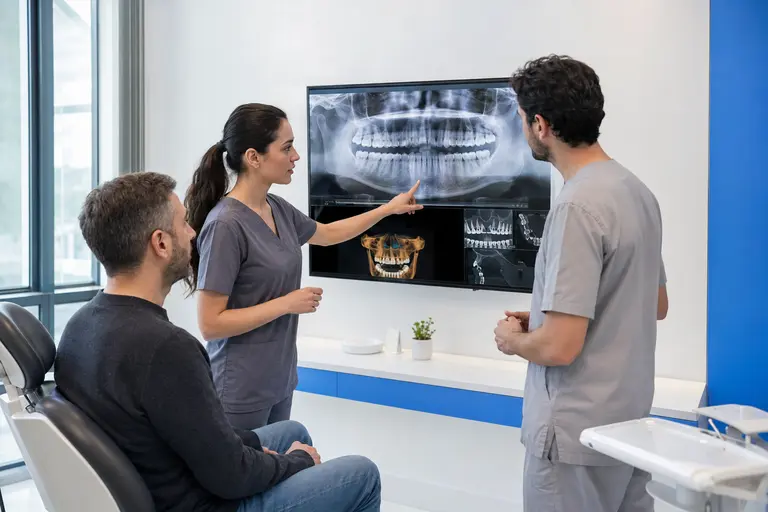
Short answer
Dental work in Turkey is safe when the clinic diagnoses properly, prepares teeth conservatively, documents every material and gives you a written price, warranty and aftercare plan. The serious cases in the news share the same pattern: treatment planned without proper imaging, healthy teeth cut down for crowns, full-mouth work rushed into one trip, and no follow-up after the patient flew home. Use the 12 checks below before you book anywhere, including with us.
Every check on this page, in writing, in your treatment plan
Send photos for a written planNothing is final until your examination in Istanbul.Quick answers · reviewed 26 October 2026
Quick answers to the questions patients ask most
Is it worth going to Turkey for dental work?
For larger treatments, yes: veneers, crowns and implants in Istanbul typically cost 60 to 75% less than private UK prices, using the same Ivoclar, Straumann and Nobel Biocare materials. It is worth it when you receive a written plan, named materials and a warranty before you travel.
Is it cheaper to get dental work done in Turkey?
Yes. At IST Smile Experts an E-Max veneer costs €235 (about £205) against £500 to £900 in the UK, and All-on-4 costs from €6,400 per jaw against £15,000 to £30,000. Even with flights and hotel, larger cases cost a fraction of private UK prices.
Why is dental cheap in Turkey?
Lower rent, salaries and laboratory costs, plus high patient volume, let Istanbul clinics charge less while using the same branded materials as the UK and US. If a price is far below the market, ask which material, how many visits and what warranty are included.
Is dentistry in Turkey better than UK?
Not better or worse by country: the materials and techniques are the same. The difference is price and speed, because Istanbul clinics finish most cosmetic cases in one 5 to 7 day trip, while the UK offers easier follow-up. Choose the clinic, not the country.
Is Turkey good for dental care?
Turkey has a large, modern private dental sector, especially in Istanbul, with digital scanning, CBCT imaging and in-house laboratories. Quality varies between clinics, so judge each one by its materials, its written plan and its Google reviews rather than by price alone.
Are Turkish dentists safe?
Most established clinics are. Safety depends on the clinic: check its sterilisation, a CBCT scan before implants, branded materials, a written plan before treatment and real patient reviews. Avoid any clinic that quotes a final price without seeing your photos or X-rays.
Prices set in euros; GBP and USD are indicative at ECB rates (€1 = £0.8578 / $1.1463). Full price list: Dental prices in Turkey 2026. Final plan and price confirmed in writing after your examination.
Why patients are asking this question in 2026
Three things have pushed safety to the top of every search about dental treatment in Turkey this year:
- High-profile complication cases. In September 2026 a UK patient told ITV’s This Morning that an infection that began in his sinuses spread to his brain after low-cost dental work in Turkey. He is taking legal action and the clinic denies wrongdoing. The British Dental Association has used the case to call for stronger action on dental tourism.
- UK dentists seeing the aftermath. In a 2022 British Dental Association survey of 1,000 UK dentists, 86% said they had treated patients for problems after dental work abroad. Crowns and implants were the most common.
- Regulators warning about how clinics recruit. In August 2026 the General Dental Council said consultation events held in UK hotels by overseas providers may be illegal, because only GDC-registered professionals can assess patients in the UK.
At the same time, access at home is hard: six in ten adults in England have not seen an NHS dentist in the past two years. So patients still travel, but they now research for months and ask much sharper questions. That is a good thing.
Where dental problems in Turkey actually come from
| What goes wrong | Why it happens | What prevents it |
|---|---|---|
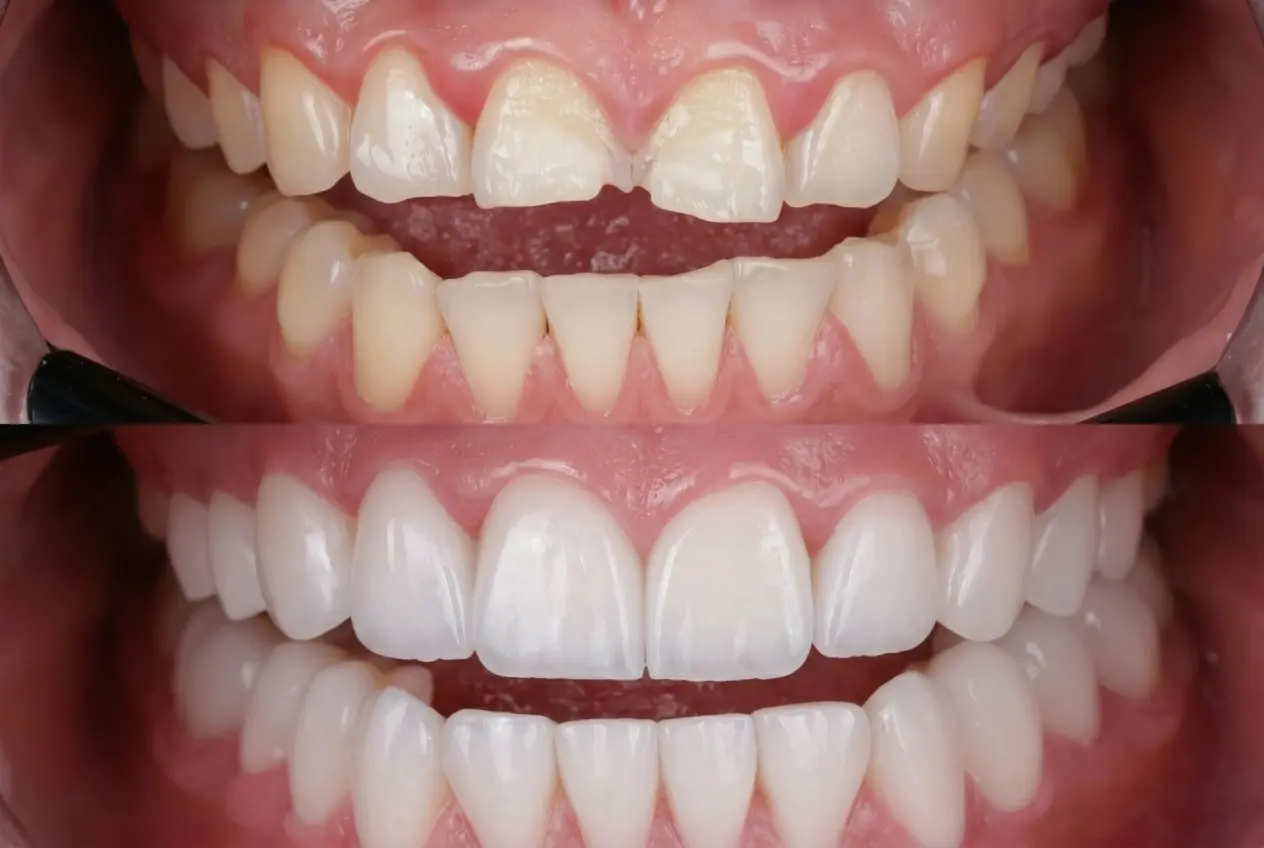
| Teeth shaved down for crowns that did not need them | Full crowns are faster and more forgiving for the clinic than thin veneers | A per-tooth plan explaining veneer vs crown, with preparation depth in mm (see preparation levels) |
| Implant failure, nerve or sinus problems | Implants placed without 3D measurement of bone, nerve and sinus | A CBCT scan, a sinus lift or bone graft when bone is thin, a known implant brand |
| Gum inflammation and decay under new teeth | Bulky margins, poor fit, rushed laboratory work | Enough days for lab work, a try-in stage, gum health treated first |
| Bite pain, chipped or broken restorations | Bite not checked after cementation; grinding ignored | Bite adjustment after bonding, a night guard for grinders |
| Nowhere to turn after flying home | No records, no remote follow-up, vague warranty | Written warranty, copies of all X-rays and material records, a named contact route |
The 12 checks before you book dental treatment in Turkey
These follow the questions the UK General Dental Council recommends asking before treatment abroad, adapted to what we see in real cases.
| # | Check | What a good answer looks like |
|---|---|---|
| 1 | Examination before the final plan | Photos and X-rays for a preliminary plan; the final plan only after an in-person examination |
| 2 | 3D imaging for implants | CBCT scan before any implant, sinus lift or bone graft decision |
| 3 | Per-tooth plan | Which teeth get veneers, crowns, bonding or nothing, and why |
| 4 | Preparation depth | Stated in millimetres; minimal preparation wherever enamel is healthy |
| 5 | Materials and brands | Named ceramics (for example Ivoclar IPS e.max) and named implant systems, recorded in your file |
| 6 | Medical history | Questions about health conditions, medication, smoking and previous surgery before treatment |
| 7 | Itemised written price | Every tooth, implant, graft and lab item listed, with what is not included |
| 8 | Written warranty | Clear terms per restoration type, in writing, before you travel |
| 9 | Realistic timeline | About 5 to 7 days for veneers or crowns; two visits for implants |
| 10 | Try-in and approval | You see and approve shape and shade before permanent bonding |
| 11 | Licensing and complaints | The facility’s Ministry of Health licence, and a clear route for concerns |
| 12 | Aftercare after you fly home | Remote review from photos and X-rays, records handed to you, and an agreed plan if a complication appears |
What happens after you message us
- Send photos of your smile, and an X-ray if you have one, on WhatsApp.
- Within 1 hour our Clinical Team replies with a written plan, an itemised price and the number of days you need.
- Choose your dates. With a package we arrange your hotel and VIP transfers. The plan is confirmed at your examination in Istanbul, before any treatment starts.
Implants and the sinus: the risk most patients never hear about
Implants in the upper back jaw sit just below the maxillary sinus. When bone there is thin, an implant can reach the sinus unless the plan accounts for it. This is why a 3D CBCT scan matters: it measures bone height and the sinus floor before surgery, and shows whether a sinus lift or bone graft is needed first.
More on implant planning: dental implants in Turkey safety checklist and implant risks and how they are prevented.
Red flags that should stop a booking
- A fixed package price for “20 crowns” before anyone has seen an X-ray
- Crowns recommended on healthy, untreated front teeth with no explanation
- No implant brand named, or “we use the best brand” with no documentation
- Full-mouth implants with final teeth promised in a single short trip, without discussing healing
- Discount deadlines, “limited spots” or pressure to pay a deposit the same day
- Assessments at UK hotel events by people who are not GDC-registered
- No written warranty, or warranty terms only given after payment
How we handle safety at IST Smile Experts
- Before you travel: our Clinical Team reviews your photos and any X-rays and gives you a preliminary written plan and itemised estimate.
- In Istanbul: the plan is confirmed only after an in-clinic examination and imaging, with CBCT for implant cases.
- Conservative first: whitening, bonding or minimal-prep veneers before crowns, wherever the tooth allows.
- Documented materials: Ivoclar E-Max ceramics, and named implant systems (Medigma, Straumann or Nobel Biocare) recorded in your file.
- You approve first: a try-in of shape and shade before anything is permanently bonded.
- Written warranty: lifetime on implant fixtures and 10 years on E-Max and zirconia restorations.
- After you fly home: remote follow-up from photos and X-rays, with your records shared with you so your home dentist can see exactly what was done.
If a case is not suitable for treatment abroad, or needs gum treatment or orthodontics first, we say so before you book.
Frequently asked questions
Is dental work in Turkey safe in 2026?
It can be, when the clinic diagnoses with an examination and X-rays (and a 3D CBCT scan for implants), chooses the least invasive treatment, documents the materials and implant brands it uses, gives a written itemised price and warranty, and has a plan for aftercare once you are home. Most serious problems reported by UK dentists trace back to skipped diagnosis, over-preparation of healthy teeth, rushed full-mouth treatment and no follow-up.
What does “Turkey teeth” actually mean?
The phrase usually describes very white, uniform full crowns placed on teeth that were heavily shaved down, often when thin veneers, bonding or whitening would have been enough. It describes a method and a look, not the country. Conservative clinics in Turkey work the other way round: minimal preparation first, crowns only where a tooth genuinely needs full coverage.
How do I check a dental clinic in Turkey before booking?
Ask for a written treatment plan per tooth after an examination, the preparation depth in millimetres, the brands of materials and implants, an itemised final price, written warranty terms, the timeline, and what happens if a complication appears after you fly home. Ask which Ministry of Health licence the facility operates under. A clinic that answers these clearly in writing is easier to trust than one that only sends a package price.
Do I need a CBCT scan before dental implants in Turkey?
For implants, especially in the upper back jaw, a 3D CBCT scan is the standard way to measure bone height and width and the distance to the sinus floor and nerves. A plan made from a 2D X-ray or photos alone cannot confirm whether a sinus lift or bone graft is needed.
Can sinus problems happen after upper dental implants?
Yes. Upper back implants sit close to the maxillary sinus. Careful 3D planning, a sinus lift where bone is too thin, and sterile surgical protocol reduce the risk. Persistent pain, swelling, nasal discharge, a bad taste, fever or pressure under the eye after upper implant surgery should be checked by a dentist or doctor straight away, wherever you are.
Who treats complications when I am back home?
Your treating clinic should stay responsible for its work, review problems remotely from photos and X-rays, and tell you clearly what is covered. Tell your home dentist about your plans before you travel, keep copies of all X-rays, scans and material records, and know how to reach the clinic after your trip.
Is a cheaper clinic in Turkey always riskier?
Not always, but very low prices usually mean something is being removed: diagnosis, material quality, laboratory time, try-in stages or aftercare. Compare plans line by line, not by the headline number.
How long should I stay in Turkey for safe dental treatment?
Veneers and crowns usually need 5 to 7 days in Istanbul so there is time for preparation, laboratory work, a try-in and final bonding. Dental implants usually need two visits 3 to 6 months apart so the implants can heal into the bone before the final teeth are fitted.
Want an honest second opinion before you book anywhere?
Send photos and any X-rays. Our Clinical Team will tell you what your case really needs, and what it does not.
Request a private safety reviewSources: ITV This Morning, patient interview (September 2026); Oral Health Group, report on BDA comments and Nuffield Trust analysis (31 August 2026); Scottish Dental magazine on GDC position (19 August 2026); General Dental Council, Going abroad for dental treatment; British Dental Association survey of 1,000 dentists (2022).