How Much Tooth Is Removed for Veneers and Crowns?
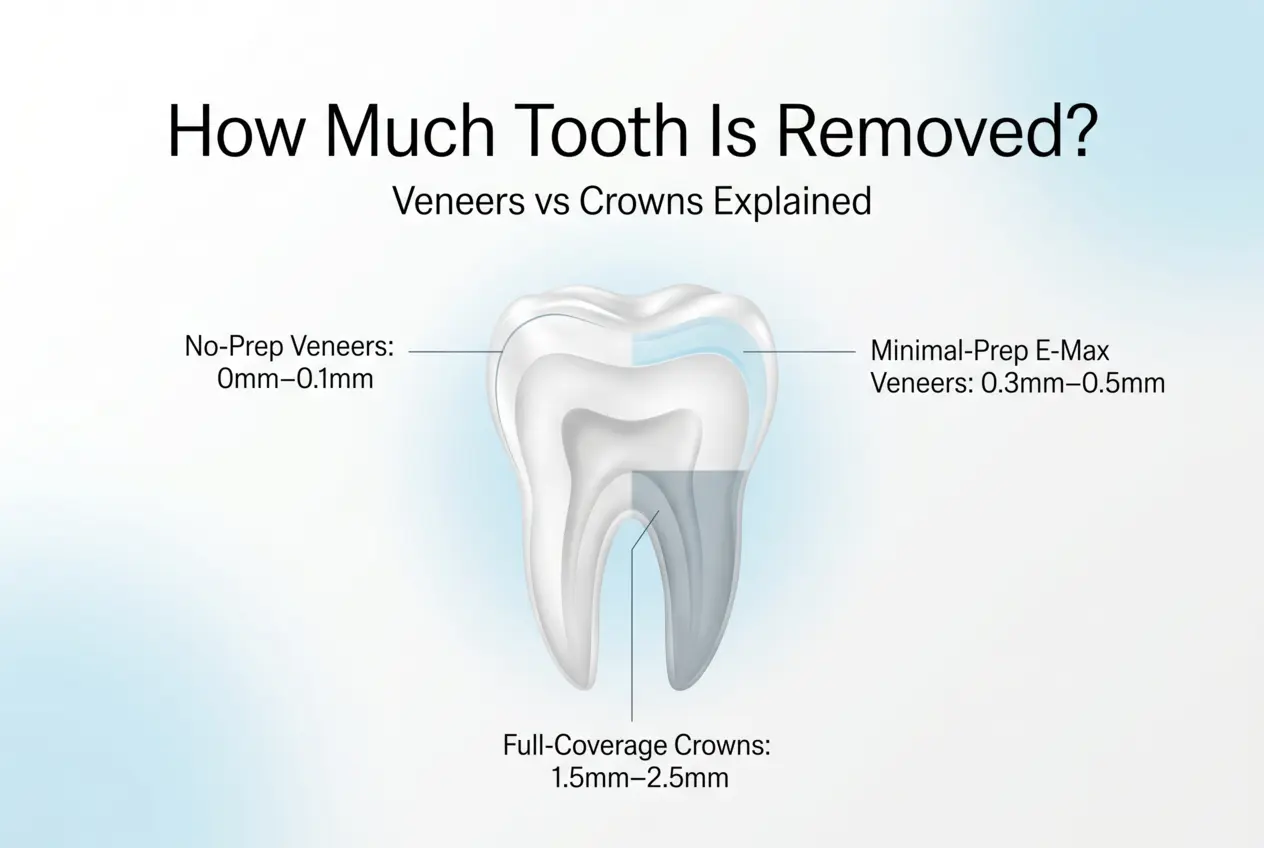
Dentists may remove 0mm to 0.1mm of enamel for no-prep veneers. Minimal-prep E-Max veneers usually require 0.3mm to 0.5mm on the front surface only. Full-coverage crowns usually require 1.5mm to 2.5mm from all tooth surfaces. The safest clinical principle is to remove the minimum amount of natural tooth structure needed for the restoration.
At a Glance: Tooth Preparation Levels
No-Prep Veneers: 0mm to 0.1mm removal. Suitable only for selected cases.
Minimal-Prep E-Max Veneers: 0.3mm to 0.5mm removal on the front surface only. This is the conservative veneer standard.
Conventional Veneers: 0.5mm to 0.8mm removal. Used when more shade masking or shape correction is required.
Full-Coverage Crowns: 1.5mm to 2.5mm removal on all surfaces. Used for damaged or structurally compromised teeth.
Clinical Rule: Remove the minimum necessary. Enamel cannot grow back once removed.
Concerned About How Much Tooth Will Be Removed?
Send us your photos. Our Clinical Team will tell you which preparation level your case requires and how much natural tooth structure can be preserved.
📲 Ask About My Preparation LevelEnamel cannot grow back after removal. That is why the preparation level your dentist chooses can affect the health of your teeth for many years.
Short answer: Tooth preparation ranges from almost zero enamel removal for no-prep veneers to 0.3mm to 0.5mm for minimal-prep E-Max veneers and 1.5mm to 2.5mm on all surfaces for full-coverage crowns. The right level depends on your tooth condition, restoration type, bite, and smile design.
Before choosing veneers or crowns, one question matters more than the price: how much natural tooth will be removed?
Once enamel is removed, it does not grow back. For this reason, tooth preparation level is one of the most important clinical decisions in cosmetic dentistry.
Many patients from the United Kingdom, United States, Canada, and Australia ask about material, shade, hotel, and price before treatment. However, the deeper question is different. What will happen to the natural teeth underneath the final smile?
This guide explains every preparation level clearly. It also explains when no-prep veneers, minimal-prep veneers, conventional veneers, and full-coverage crowns are clinically appropriate.
Veneers vs Crowns: How Much Tooth Is Removed?
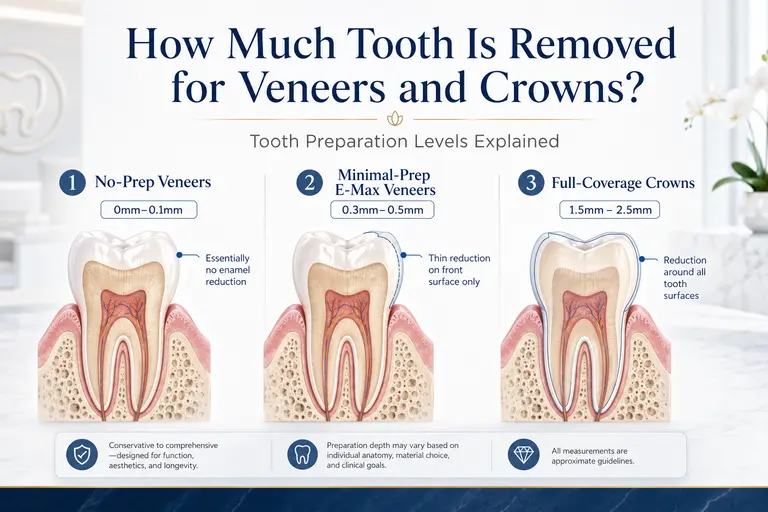
The easiest way to understand tooth preparation is to compare veneers and crowns directly.
Veneers usually treat the front surface of the tooth. Crowns cover the full tooth. Therefore, crown preparation removes significantly more natural tooth structure.
| Treatment | Tooth Removal | Where Tooth Is Removed | Best For |
|---|---|---|---|
| No-Prep Veneers | 0mm to 0.1mm | Little to none | Small or slightly recessed teeth |
| Minimal-Prep E-Max Veneers | 0.3mm to 0.5mm | Front surface only | Healthy teeth needing cosmetic improvement |
| Conventional Veneers | 0.5mm to 0.8mm | Front surface only | Darker teeth or more complex aesthetic correction |
| Full-Coverage Crowns | 1.5mm to 2.5mm | All surfaces | Damaged, root-canal, cracked, or structurally weak teeth |
Clinical note: Preparation depth varies by tooth anatomy, bite, material thickness, shade requirement, and final smile design. Exact preparation must always be determined clinically after examination and digital planning.
The Four Tooth Preparation Levels in Cosmetic Dentistry
Tooth preparation level is the depth of enamel or tooth structure removed before placing a restoration.
Modern cosmetic dentistry uses four main preparation categories. Each one has a different purpose.
Level 1: No-Prep Veneers
Dentists place no-prep veneers with little or no enamel reduction. In many cases, the tooth surface remains almost unchanged.
This option is the most conservative. However, it is not suitable for every patient.
No-prep veneers work best when the natural teeth are slightly small, slightly short, or positioned a little behind the ideal smile line. In these cases, adding a thin layer of porcelain can improve shape and proportion without making the teeth look too bulky.
However, no-prep veneers can look thick or prominent on teeth that already have the correct size.
No-prep veneers may be suitable if:
- Your teeth are naturally small or short
- Your teeth are slightly set back
- Added volume improves your smile proportions
- You accept the aesthetic limitations of no-prep treatment
No-Prep
0mm
Most conservative
Selected cases only
Level 2: Minimal-Prep E-Max Veneers
Minimal-prep veneers are the conservative standard for many E-Max veneer cases.
In this protocol, the dentist removes about 0.3mm to 0.5mm of enamel from the front surface only. This creates space for the porcelain veneer while preserving most of the natural tooth.
This matters because enamel is the best bonding surface for porcelain veneers. When the preparation stays mostly within enamel, the bond becomes stronger and more stable.
At IST Smile Experts, this is our standard approach for healthy teeth that need cosmetic improvement. The goal is not only to create a beautiful smile. The goal is to create that smile while preserving as much natural tooth structure as possible.
Why this matters:
Some clinics remove far more enamel than necessary for standard veneer cases. This may create a fast cosmetic result, but it can weaken the tooth underneath. Conservative preparation protects the long-term health of the tooth.
Minimal-Prep
0.3-0.5mm
Front surface only
Enamel focused
Level 3: Conventional Veneer Preparation
Conventional veneer preparation removes more enamel than minimal-prep treatment.
This level may be needed when the tooth is darker, more rotated, or needs more ceramic thickness to achieve the desired result.
However, conventional preparation should not be the default for every veneer patient. The more conservative option usually protects long-term tooth health better when it can achieve the same result with less enamel removal.
Conventional
0.5-0.8mm
More correction
Case-specific
Level 4: Full-Coverage Crown Preparation
Full-coverage crown preparation is much more aggressive than veneer preparation.
Instead of preparing only the front surface, the dentist prepares the entire tooth. This includes the front, back, sides, and biting surface.
Crowns are clinically useful when the tooth is damaged, cracked, root-canal treated, heavily filled, or structurally weak. In those cases, full coverage protects the tooth.
However, preparing a healthy tooth for a crown purely for cosmetic reasons removes far more natural structure than necessary.
Crowns may be needed if:
- The tooth has had root canal treatment
- The tooth has a large old filling
- The tooth is cracked or fractured
- The tooth has extensive decay
- The bite needs full structural correction
Full Crown
1.5-2.5mm
All surfaces
Most invasive
Do Veneers Ruin Your Teeth?
Veneers do not ruin teeth when the case is selected correctly and the preparation stays conservative.
The veneer itself is not the problem. Aggressive preparation on teeth that could have been treated more conservatively creates the real risk.
When E-Max veneers are placed on healthy teeth with 0.3mm to 0.5mm enamel preparation, most of the natural tooth structure is preserved.
However, when a dentist removes 1.0mm to 1.5mm or more for a cosmetic veneer case, the tooth may lose too much enamel. As a result, the tooth may become more dependent on future restorations.
This is why patients should ask how much tooth will be removed before approving treatment.
The Real Risk of Cheap Veneers in Turkey: Over-Preparation
The biggest risk in low-cost veneer tourism is not the flight, the hotel, or the material name.
Aggressive tooth preparation creates the real risk.
Some clinics prepare healthy teeth as if they were crown cases, even when the patient only needs veneers. This can create a dramatic before-and-after result quickly, but it may permanently weaken the natural teeth underneath.
At IST Smile Experts, the clinical goal is different. We do not judge a smile makeover only by how it looks on the final day. We also judge it by how much healthy tooth structure remains after the result is achieved.
The rule of responsible cosmetic dentistry:
Remove only what the restoration requires. Never remove more because it is faster, easier, or cheaper to execute. The patient keeps that tooth for life.
Why Preparation Level Determines Your Long-Term Result
Preparation depth is not just a technical measurement. It affects your teeth for many years after treatment.
1. Bond Strength
Enamel is the ideal bonding surface for porcelain veneers.
When preparation stays within enamel, the veneer bonds more predictably. However, when preparation exposes dentin, the bond may become weaker because dentin has different moisture and surface properties.
For this reason, conservative preparation supports longer-lasting veneer treatment.
2. Sensitivity
The deeper the preparation, the closer the tooth surface gets to the nerve inside the tooth.
Minimal-prep veneer treatment usually stays within the enamel layer. As a result, sensitivity is usually limited and temporary.
In contrast, aggressive preparation may increase the risk of prolonged sensitivity.
3. Future Treatment Options
Conservative preparation keeps more enamel available for future bonding.
This matters because veneers may need replacement after many years. If enough enamel remains, replacement is usually easier and more conservative.
If too much enamel was removed during the first treatment, the future options may become more limited. In some cases, the tooth may need a crown instead of a replacement veneer.
The IST Smile Experts Conservative Preparation Protocol
At IST Smile Experts, preparation is not planned from the price list. It is planned from the tooth.
Our clinical protocol follows three rules:
- Preserve enamel whenever possible because enamel is the strongest bonding surface for veneers.
- Use crowns only when clinically justified because crown preparation removes significantly more natural tooth structure.
- Approve the smile design before preparation so the amount of preparation is guided by a controlled final design, not by guesswork.
This is why our approach focuses on long-term tooth preservation, not just a fast cosmetic result.
Intraoral Clinical Mock-up Before Tooth Preparation
When clinically appropriate, veneer planning includes a reversible intraoral clinical mock-up before any irreversible tooth preparation.
This helps the Clinical Team understand how much space the final restoration needs before any tooth structure is removed.
Therefore, preparation follows the approved design rather than guesswork.
Temporary Veneers After Preparation
Temporary veneers are placed after preparation while the final veneers are being produced.
This protects the prepared surface, reduces sensitivity, and keeps the smile presentable during the treatment process.
Crowns Only When Clinically Needed
IST Smile Experts recommends crowns when the tooth needs full structural protection.
Healthy teeth that can be treated with conservative veneers are not prepared as crowns by default.
Which Preparation Level Is Right for Your Case?
Consider no-prep veneers if:
Your teeth are naturally small, slightly short, or slightly set back. This option works only when added veneer thickness improves the smile instead of making it bulky.
Minimal-prep E-Max veneers are right if:
Your teeth are structurally healthy and your concern is mainly aesthetic, such as shade, shape, small gaps, or mild alignment.
Conventional preparation may be needed if:
Your teeth have stronger discoloration or need more correction than minimal-prep treatment can safely achieve.
Crown preparation is required if:
The tooth is root-canal treated, heavily filled, cracked, decayed, or structurally weak and needs full-coverage protection.
Questions to Ask Before Getting Veneers
Before approving veneer treatment, patients should ask clear clinical questions.
- How much enamel will be removed from each tooth?
- Will the preparation stay within enamel?
- Are my teeth healthy enough for veneers instead of crowns?
- Will I review an intraoral clinical mock-up before preparation, when clinically appropriate?
- Will I have a final restoration try-in before bonding?
- Will I receive temporary veneers after preparation?
- What happens if I need replacement veneers in 15 to 20 years?
If a clinic cannot answer these questions clearly, the patient should be cautious before approving treatment.
Related Treatment Information
For complete information about conservative E-Max veneer treatment, read our minimal-prep E-Max veneers in Turkey guide.
If you are comparing veneers, crowns, and bonding, read our E-Max vs zirconia vs composite comparison.
For damaged or heavily restored teeth, see our zirconia crowns preparation and full-coverage restorations guide.
Patients with old or over-prepared veneers can also read our over-prepared veneers and veneer replacement cases guide.
Most patients who contact us about veneers are not only asking about the final smile. They are asking whether their natural teeth will be protected. The honest answer depends on your teeth, your bite, and the preparation level your case requires.
Frequently Asked Questions
Veneer Preparation Questions
How much tooth is removed for veneers?
For no-prep veneers, little or no enamel may be removed. For minimal-prep E-Max veneers, dentists usually remove about 0.3mm to 0.5mm from the front surface only. For conventional veneers, removal may be around 0.5mm to 0.8mm depending on the case.
Do all veneers require shaving teeth?
No. Some selected cases can be treated with no-prep or very minimal-prep veneers. However, many veneer cases need a small amount of preparation to create space for the porcelain and avoid a bulky result.
What is the safest veneer preparation level?
The safest preparation level is the minimum amount needed to achieve the planned result while preserving enamel. For many E-Max veneer cases, this is about 0.3mm to 0.5mm.
Can I get veneers if I do not want my teeth shaved?
Possibly, but only if your tooth shape and position allow it. No-prep veneers can look bulky when used on teeth that are already the correct size. A clinical assessment is needed before deciding.
Veneers, Crowns and Tooth Health
Do veneers ruin your natural teeth?
Veneers do not ruin teeth when the case is selected correctly and preparation is conservative. The main risk comes from aggressive preparation, especially when healthy teeth are prepared like crowns.
What is the difference between veneer preparation and crown preparation?
Veneer preparation usually affects only the front surface of the tooth. Crown preparation affects the full tooth and removes much more structure. Veneers are usually for healthy teeth with cosmetic concerns, while crowns are for structurally damaged teeth.
How much tooth is removed for a crown?
A full-coverage crown usually requires about 1.5mm to 2.5mm of tooth reduction from all surfaces. The exact amount depends on the material, tooth condition, bite, and clinical design.
How do I know if I need veneers or crowns?
Veneers are usually better for healthy teeth with cosmetic concerns. Crowns are usually better for teeth that are cracked, heavily filled, root-canal treated, decayed, or structurally weak.
Over-Preparation and Long-Term Risks
Are Turkish veneers shaved down too much?
Some low-cost veneer cases may involve aggressive preparation, but this is not required for proper veneer treatment. The key is the clinic's protocol. Healthy teeth should not be prepared like crown cases when veneers are clinically enough.
What happens if a dentist over-prepares a tooth for veneers?
Over-preparation may expose dentin, weaken bonding, increase sensitivity, and reduce future treatment options. In severe cases, the tooth may need a crown instead of a replacement veneer later.
Can over-prepared teeth be fixed?
Often, yes. However, the options depend on how much enamel remains. Some over-prepared teeth can receive replacement veneers, while others may require crowns for better structural coverage.
Why does preparation level matter for long-term veneer success?
Preparation level determines how much enamel remains. Enamel is the ideal bonding surface for veneers. When enough enamel remains, the veneer bond is usually more stable and future replacement options are better preserved.
Your Preparation Level Should Be a Clinical Decision, Not a Default
Before any preparation begins at IST Smile Experts, your case is reviewed clinically, your smile design is planned, and the correct preparation level is selected for each tooth.
To begin your assessment, send us:
Front, side, and smile photographs · Any existing X-rays available · A description of your aesthetic goals and any previous dental work
Our Clinical Team will specify the correct preparation level for your case and respond with a personalised treatment plan within 12 hours.
Or email: info@istsmileexperts.com