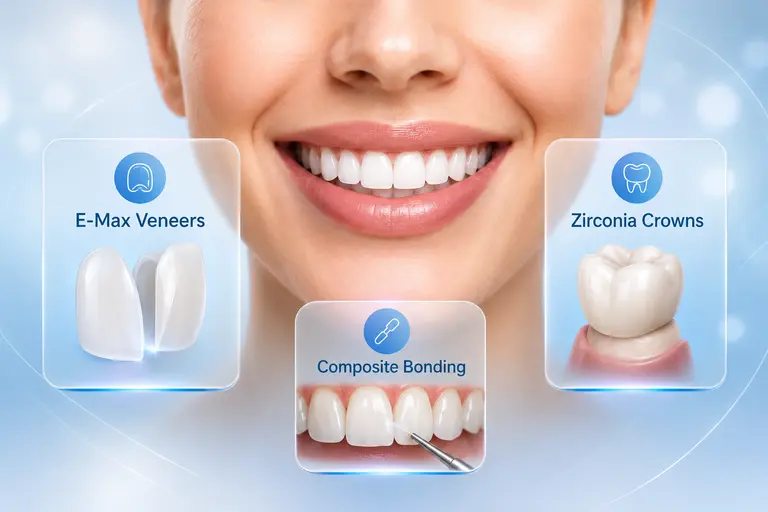
E-Max Veneers vs Zirconia Crowns vs Composite Bonding: Choose the Right Smile Treatment Before You Travel
Not sure whether you need E-Max veneers, zirconia crowns, or composite bonding? This is exactly the mistake many international patients make before travelling to Turkey. They compare prices first, then discover later that they chose the wrong material for their teeth.
At IST Smile Experts in Istanbul, the clinical team reviews your photos before recommending a treatment. The goal is simple: protect healthy teeth, avoid unnecessary shaving, choose the right material, and create a natural smile that fits your face.
Clinical answer: E-Max veneers are usually best for healthy front teeth when the goal is a natural translucent smile. Zirconia crowns are usually better for damaged, dark, root-canal-treated, heavily filled, or high-bite-force teeth that need full coverage. Composite bonding is usually best for small chips, minor gaps, uneven edges, and conservative smile improvements.
Get the right treatment plan before booking flights
Send your smile photos on WhatsApp. Our team will tell you which option is more suitable for your teeth, how many units may be needed, estimated treatment time in Istanbul, and whether you should consider hotel and VIP transfer support.
If you are comparing E-Max veneers, zirconium crowns, and composite bonding in Turkey, do not start with the cheapest quote. Start with diagnosis. Healthy enamel may only need minimal-prep E-Max veneers. Weak or heavily restored teeth may need zirconium crowns. Small cosmetic defects may be better served with 3M composite bonding instead of permanent ceramic work.
This guide gives you a clear clinical and commercial comparison, including aesthetics, tooth preparation, durability, cost, treatment timeline, and case suitability. It is designed for international patients from the UK, USA, Canada, Australia, Ireland, Germany, France, Italy, Portugal, Poland, the Netherlands, and Switzerland who want a premium dental plan in Istanbul without being pushed into unnecessary treatment.
Do Not Guess Your Treatment
Choosing crowns when veneers are enough can remove healthy tooth structure. Choosing bonding when ceramic is needed can lead to short-lived results. Send your photos and get a clear direction before you travel.
Which Treatment Is Right for You?
The best cosmetic dental treatment is not the strongest material or the cheapest offer. It is the option that solves your problem while preserving as much healthy tooth structure as possible.
E-Max Veneers
Best for natural aesthetics.
- Healthy front teeth
- Natural translucency
- Smile zone makeovers
- Minimal preparation in suitable cases
- Premium Hollywood Smile results
Typical IST Smile Experts price: €235 per tooth.
Zirconia Crowns
Best for strength and coverage.
- Damaged or heavily filled teeth
- Dark teeth or root-canal-treated teeth
- Bruxism and heavy bite cases
- Old crown replacement
- Full-mouth restoration cases
Typical IST Smile Experts price: €215 per tooth.
Composite Bonding
Best for small corrections.
- Minor chips
- Small gaps
- Uneven edges
- Shape correction without ceramic
- Trial smile improvements
Typical IST Smile Experts price: €185 per tooth using 3M composite bonding.
Still unsure? Send 3 to 5 smile photos and we will tell you which treatment direction is safer for your teeth.
E-Max vs Zirconia vs Composite: Side-by-Side Comparison
This table compares the three options by function, aesthetics, preparation, durability, treatment time, and cost. On mobile, use the card comparison below the table for easier reading.
| Feature | E-Max Veneers | Zirconia Crowns | Composite Bonding |
|---|---|---|---|
| Main purpose | Natural cosmetic smile redesign | Strength, coverage, and restoration | Conservative correction of small defects |
| Material | Ivoclar E-Max lithium disilicate ceramic | Zirconium oxide ceramic | 3M resin composite bonding |
| Best for | Healthy front teeth, natural smile makeovers, minimal-prep cases | Damaged teeth, dark teeth, bruxism, old crowns, full coverage | Small chips, gaps, edge reshaping, minor cosmetic improvements |
| Natural translucency | Excellent for front teeth | Good with modern multilayer zirconia, but less translucent than E-Max | Good for small corrections, less ceramic-like long term |
| Tooth preparation | Often around 0.3 to 0.4 mm in suitable minimal-prep cases | More preparation because it covers the full tooth | Often little or no drilling depending on the case |
| Strength | Strong for cosmetic front-tooth veneers when bite is suitable | Highest strength among the three options | Lower strength, easier to repair |
| Stain resistance | High | High | Moderate, may need polishing or refreshing |
| Typical longevity | Long-term ceramic solution when planned correctly | Long-term restorative solution when clinically indicated | Shorter lifespan than ceramic, maintenance required |
| Reversibility | Not reversible once tooth preparation is done | Not reversible because it is full coverage | More conservative and may be removable in suitable cases |
| Treatment time in Istanbul | Usually 5 to 7 days | Usually 5 to 7 days | Often completed faster depending on number of teeth |
| IST Smile Experts price | €235 per tooth | €215 per tooth | €185 per tooth |
E-Max Veneers
Best for: healthy front teeth, natural aesthetics, premium smile zone redesign.
Preparation: often around 0.3 to 0.4 mm in suitable cases.
Price: €235 per tooth.
Zirconia Crowns
Best for: damaged, dark, heavily filled, root-canal-treated, or high-bite-force teeth.
Preparation: more preparation because it covers the full tooth.
Price: €215 per tooth.
Composite Bonding
Best for: minor chips, small gaps, uneven edges, and conservative cosmetic improvement.
Preparation: often little or no drilling depending on the case.
Price: €185 per tooth.
The biggest mistake: choosing crowns when your teeth only need veneers, or choosing composite bonding when your teeth actually need stronger ceramic restoration. Many unnatural “Turkey teeth” results happen because the treatment type was wrong before the material was even selected.
Before accepting any treatment plan, let our team check whether your teeth need veneers, crowns, bonding, or a different approach.
When E-Max Veneers Are the Best Choice
E-Max veneers are usually the premium option for patients who want a natural, elegant smile redesign while keeping the treatment as conservative as the case allows. E-Max is made from lithium disilicate ceramic and is known for its enamel-like translucency, making it especially suitable for front teeth and visible smile-zone cases.
E-Max is often the right choice when your teeth are structurally healthy but have cosmetic problems such as discoloration, mild shape irregularity, small gaps, worn edges, or an old smile design you no longer like. It is also ideal when the goal is a natural Hollywood Smile that does not look flat, bulky, opaque, or artificial.
Choose E-Max veneers if:
- Your front teeth are generally healthy.
- You want the most natural-looking ceramic result.
- You want a brighter, more harmonious smile without a fake opaque look.
- Your case is suitable for minimal-prep veneers.
- You want a long-term cosmetic solution instead of short-term bonding.
Avoid E-Max veneers if:
- Your teeth are severely damaged or structurally weak.
- You have severe bruxism that requires stronger full-coverage protection.
- Your teeth are very dark and need stronger masking.
- Your existing teeth already have large crowns or heavy restorations.
For a dedicated explanation of E-Max materials, preparation, prices, and package options, read our full E-Max veneers Turkey guide.
Think E-Max veneers may fit your case?
When Zirconia Crowns Are the Best Choice
Zirconia crowns are usually recommended when the tooth needs strength, protection, or full coverage. Unlike veneers, crowns cover the entire visible tooth structure. This makes them more invasive than veneers, but also more protective when the tooth is already damaged, heavily filled, root-canal-treated, dark, or structurally compromised.
Zirconia is a strong ceramic material used for crowns, bridges, and full-mouth restorative cases. It is especially useful for patients who grind their teeth, have a heavy bite, or need to replace old crowns with a more aesthetic metal-free option.
Choose zirconia crowns if:
- Your teeth are damaged, cracked, or heavily restored.
- You already have old crowns that need replacement.
- You have root-canal-treated teeth that require protection.
- You have dark teeth that need stronger masking.
- You need full-mouth restoration or bridge work.
- You have bruxism or heavy bite forces.
Avoid zirconia crowns if:
- Your teeth are healthy and only need cosmetic improvement.
- You are suitable for minimal-prep veneers.
- You want to avoid unnecessary full-coverage preparation.
Premium positioning note: zirconia is not “better” than E-Max for every patient. It is better when the tooth needs coverage and strength. If a clinic recommends crowns for healthy teeth without explaining why, ask for a second opinion before accepting the plan.
For the full explanation of material choice, preparation, prices, and case suitability, read our Zirconium Crowns Turkey guide.
Have damaged, dark, old crowned, or root-canal-treated teeth?
When Composite Bonding Is the Best Choice
Composite bonding is a conservative cosmetic treatment where tooth-colored resin is sculpted directly onto the tooth. At IST Smile Experts, we use premium 3M composite bonding for suitable cases. This treatment can improve small chips, minor gaps, edge irregularities, and selected shape problems without the same level of tooth preparation needed for ceramic restorations.
Composite bonding is not a full replacement for E-Max veneers or zirconium crowns. It is best for minor improvements, trial smile design, or patients who want a conservative option before committing to ceramic. It can look very good when planned correctly, but it is more prone to staining and wear compared with ceramic.
Choose composite bonding if:
- You have small chips or uneven edges.
- You have minor gaps or slight shape problems.
- You want a conservative treatment with little or no drilling in suitable cases.
- You want a lower-cost improvement before permanent ceramic veneers.
- You understand that maintenance and polishing may be needed over time.
Avoid composite bonding if:
- You want the most durable long-term smile makeover.
- You have large color changes that require ceramic masking.
- Your teeth need full structural protection.
- You want the highest stain resistance.
For the full explanation, pricing, and case suitability, read our Composite Bonding in Turkey guide.
Want a conservative smile improvement without jumping straight to ceramic?
How Much Tooth Is Removed?
This is one of the most important questions international patients ask before cosmetic dental treatment. Patients do not only want whiter teeth. They want to know whether their natural teeth will be protected.
Clinical answer: E-Max veneers usually require less tooth preparation than zirconia crowns because veneers cover mainly the visible front surface of the tooth, while zirconia crowns cover the full tooth. Composite bonding is often the most conservative option because it may require little or no drilling in suitable cases.
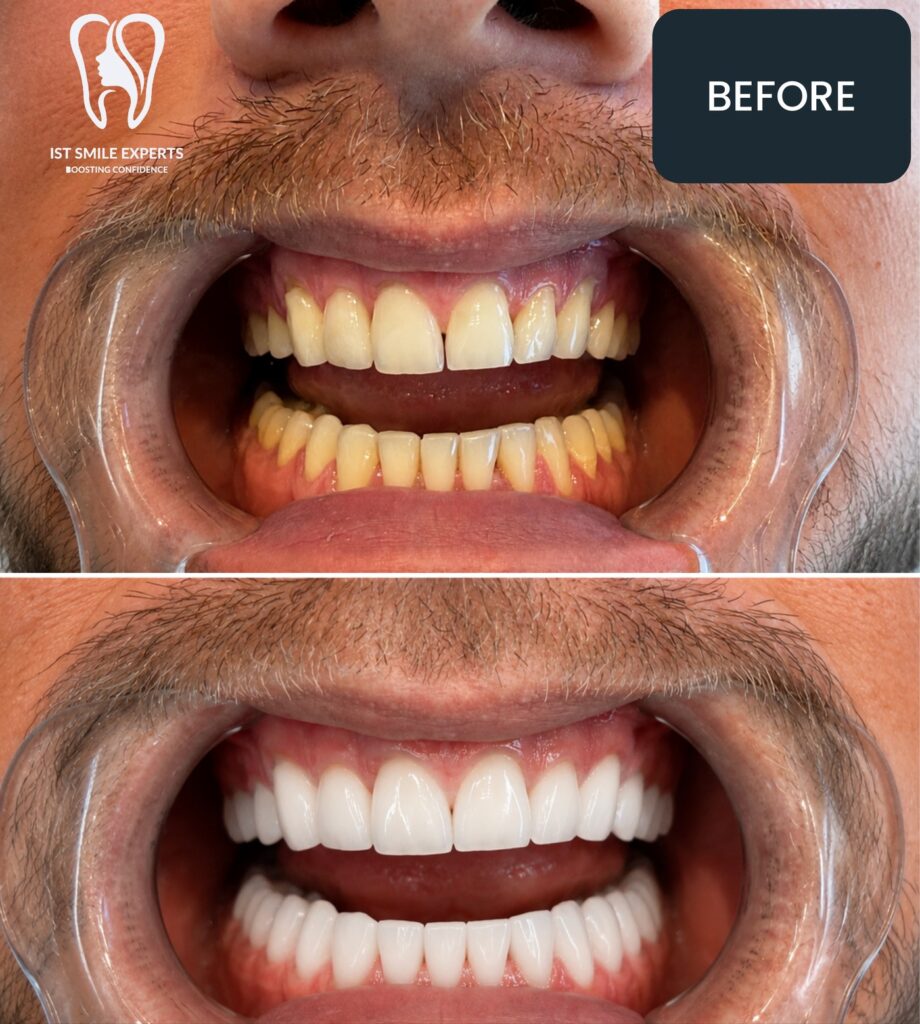
Real patient · IST Smile Experts
E-Max full smile makeover
- Time in Istanbul
- 6 to 7 days, one trip
- Materials
- Ivoclar IPS e.max, minimal preparation, try-in before bonding
- Investment
- 20 E-Max veneers package · €4,950
Veneers or Crowns: The Mistake Patients Must Avoid
Many international patients arrive in Turkey asking for “veneers,” but what they actually receive in some clinics is full-coverage crowns. This is one of the main reasons people later search for terms such as Turkey teeth gone wrong, teeth shaved for veneers, crowns vs veneers Turkey, and bad veneers replacement.
The distinction is simple but clinically important: veneers are a cosmetic restoration for teeth that still have enough healthy structure. Crowns are a protective restoration for teeth that need full coverage. If the teeth are healthy, crowns may be unnecessarily aggressive. If the teeth are weak, veneers may be insufficient.
That is why IST Smile Experts starts with case evaluation before recommendation. The clinical team reviews your current tooth condition, photos, bite, gum line, existing fillings, and previous dental work before recommending E-Max veneers, zirconia crowns, composite bonding, or another plan.
If Your Teeth Were Already Shaved Too Much
If you previously had cosmetic dental work and your natural teeth were heavily reduced, the decision becomes more complex. In some cases, replacing old veneers with new E-Max veneers may still be possible. In other cases, zirconia crowns may be safer because the remaining tooth structure needs full coverage protection.
This is why patients unhappy with old, bulky, painful, fake-looking, or failed veneers should not choose a new treatment based only on photos. They need a corrective assessment. If this applies to you, read our dedicated Veneer Replacement Turkey guide.
Cost Comparison at IST Smile Experts
Price matters, but it should never be the first decision point. A cheap crown on a tooth that only needed bonding is expensive in the long term. A cheap veneer on a tooth that needed structural support can fail early. The right treatment protects both your smile and your future dental options.
| Treatment | IST Smile Experts Price | Best For | Package Notes |
|---|---|---|---|
| E-Max Veneers | €235 per tooth | Natural cosmetic smile redesign | Usually 5 to 7 days in Istanbul for full smile cases |
| Zirconium Crowns | €215 per tooth | Strength, coverage, old crown replacement, damaged teeth | Package pricing available for 6, 8, 10, 12, 16, 20, 24, and 28 units |
| Composite Bonding | €185 per tooth | Small chips, gaps, edges, conservative correction | Timing depends on number of teeth and case complexity |
E-Max Veneers Cost
€235 per tooth. Best for natural cosmetic smile redesign.
Zirconium Crowns Cost
€215 per tooth. Best for strength, coverage, and damaged teeth.
Composite Bonding Cost
€185 per tooth. Best for minor chips, gaps, and conservative corrections.
Cash prices are the base prices. If you prefer to pay by card, a 15% bank fee is added to the total. Full packages can include hotel accommodation and VIP transfers depending on the treatment plan.
How IST Smile Experts Decides Your Plan
The right material is selected through clinical logic, not sales pressure. For international patients, the process usually starts with remote photo assessment. This helps the team understand whether the case is mainly cosmetic, restorative, functional, or corrective.
Clinical standard: if bonding is enough, we do not push veneers. If veneers are enough, we do not push crowns. If crowns are necessary, we explain why. This is how premium cosmetic dentistry avoids fake-looking results and unnecessary tooth damage.
Quick Decision Guide
| Your Situation | Usually Best Option | Why |
|---|---|---|
| Healthy front teeth, cosmetic improvement needed | E-Max veneers | Natural translucency with conservative planning in suitable cases |
| Small chips, minor gaps, uneven edges | Composite bonding | Conservative, faster, and lower-cost correction |
| Root-canal-treated or dark teeth | Zirconia crowns | Better masking and full coverage protection |
| Bruxism or heavy bite | Zirconia crowns or carefully selected ceramic plan | Strength and bite protection matter more than cosmetic translucency |
| Old bulky veneers or failed cosmetic work | Corrective assessment first | The remaining tooth structure determines whether veneers or crowns are safer |
| You want a trial before permanent veneers | Composite bonding or digital smile preview | Lets you test shape direction before full ceramic treatment |
Healthy front teeth
Usually best option: E-Max veneers.
Why: natural translucency with conservative planning in suitable cases.
Small chips, gaps, or uneven edges
Usually best option: Composite bonding.
Why: conservative, faster, and lower-cost correction.
Root-canal-treated or dark teeth
Usually best option: Zirconia crowns.
Why: better masking and full coverage protection.
Bruxism or heavy bite
Usually best option: Zirconia crowns or a carefully selected ceramic plan.
Why: strength and bite protection matter more than cosmetic translucency.
Old bulky veneers or failed cosmetic work
Usually best option: Corrective assessment first.
Why: the remaining tooth structure determines whether veneers or crowns are safer.
Trial before permanent veneers
Usually best option: Composite bonding or digital smile preview.
Why: lets you test shape direction before full ceramic treatment.
Get the Right Treatment Before You Travel
Choosing the wrong material can cost more than choosing the right clinic. Send your photos and our clinical team will guide you toward the safest option for your teeth.
What Happens After You Contact Us?
This page helps you understand the options. The next step is a real case review. Send your photos on WhatsApp and the IST Smile Experts team will guide you with a practical treatment direction before you travel to Istanbul.
For a side-by-side clinical comparison of strength, translucency and where each material belongs in the mouth, read our guide to multi-layer vs monolithic zirconia crowns.
Frequently Asked Questions
Aesthetics and Material Choice
Which is better: E-Max veneers, zirconia crowns, or composite bonding?
There is no single best option for everyone. E-Max veneers are usually best for healthy front teeth and natural aesthetics. Zirconia crowns are usually best for damaged, dark, heavily filled, or high-bite-force teeth that need full coverage. Composite bonding is usually best for minor chips, gaps, and conservative cosmetic corrections.
Which option looks the most natural?
E-Max veneers usually provide the most natural translucency for front teeth because they can reflect light in a way that closely resembles natural enamel. Zirconia can also look attractive, especially modern multilayer zirconia, but it is usually less translucent than E-Max. Composite can look natural for small corrections but may lose polish or stain faster over time.
Which option is the strongest?
Zirconia crowns are generally the strongest option and are often used for damaged teeth, old crowns, bridges, bruxism cases, and full-mouth restorations. E-Max is strong enough for many cosmetic veneer cases when the bite is suitable. Composite bonding is less strong than ceramic but easier to repair.
Are zirconia crowns bad for front teeth?
No. Zirconia crowns can be excellent for front teeth when the case requires strength, masking, or full coverage. However, if the front teeth are healthy and only need cosmetic improvement, E-Max veneers may be more conservative and more natural-looking. The decision depends on tooth condition, shade, bite, and existing restorations.
Tooth Preparation and Safety
Which option requires the least tooth shaving?
Composite bonding usually requires the least tooth preparation and may need little or no drilling in suitable cases. E-Max veneers can often be planned with minimal preparation, commonly around 0.3 to 0.4 mm depending on the case. Zirconia crowns require more preparation because they cover the full tooth.
Do veneers always mean shaving teeth down?
No. E-Max veneers do not always require aggressive shaving. In suitable cases, they can be planned with minimal enamel preparation. However, preparation depends on tooth alignment, shade, protrusion, bite, and the desired final smile design. Healthy teeth should not be over-prepared just to fit a generic smile design.
What if my teeth were already shaved too much?
If your teeth were already heavily reduced from previous dental work, the safest option depends on how much healthy structure remains. Some cases can still be corrected with veneers, while others may need zirconia crowns for full coverage protection. A corrective assessment is necessary before deciding.
Can composite bonding replace veneers?
Composite bonding can replace veneers only in selected minor cases where the teeth need small shape corrections and do not require ceramic coverage. For full smile redesigns, deep shade changes, worn teeth, or long-term ceramic aesthetics, E-Max veneers or zirconia crowns may be more suitable.
Durability, Bite, and Maintenance
Which option is best for bruxism or teeth grinding?
For patients with bruxism or heavy bite forces, zirconia crowns are often preferred when teeth need full coverage. However, some veneer cases can still be planned carefully if the bite is suitable and a night guard is used. The bite must be assessed before choosing E-Max, zirconia, or composite.
Which option stains the fastest?
Composite bonding usually stains faster than E-Max veneers or zirconia crowns because it is a resin material, not ceramic. E-Max and zirconia have higher stain resistance. Composite bonding may need polishing, refreshing, or repair over time to maintain its appearance.
Travel, Cost, and Planning
How much do E-Max, zirconia, and composite bonding cost in Turkey?
At IST Smile Experts, E-Max veneers are typically €235 per tooth, zirconium crowns are typically €215 per tooth, and 3M composite bonding is typically €185 per tooth. Final pricing depends on the number of teeth, material choice, case complexity, hotel package, transfers, and payment method.
How long should I stay in Istanbul?
For full E-Max veneer or zirconia crown cases, international patients usually stay around 5 to 7 days depending on the treatment plan. Composite bonding can often be completed faster depending on the number of teeth and case complexity. Your coordinator will confirm the exact schedule after clinical review.
Prefer a no-drill option first? Composite bonding in Istanbul starts from €185 per tooth, usually needs no enamel removal and is finished in one or two days.
Ready to Know Which Treatment You Actually Need?
Send your photos now and get a clear recommendation before you book flights. We will tell you whether your case is better for E-Max veneers, zirconia crowns, composite bonding, or a more conservative plan.
Your next step
Ready for a natural E-Max smile, planned before you fly?
- Send 3 photos of your smile, and an X-ray if you have one, on WhatsApp.
- Within 1 hour our Clinical Team replies. You then receive a written, itemised plan with your final price and the days you need.
- Choose your dates. We book your hotel and VIP transfers. Nothing is final until your examination in Istanbul.
No commitment until you approve your written plan · Try-in before anything is bonded · 10-year written warranty on E-Max