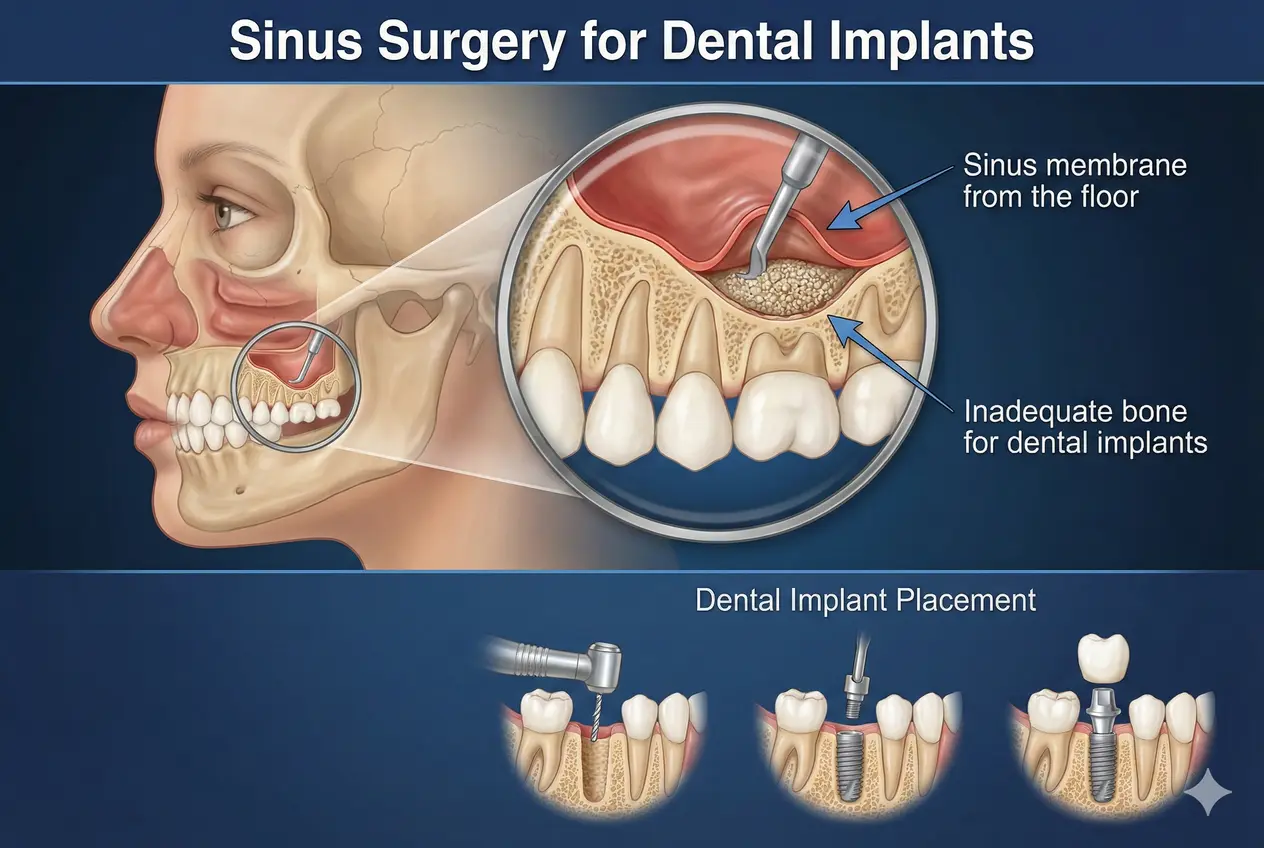
Quick Answer: When Is a Sinus Lift Needed?
Your clinical team may recommend a sinus lift, also called maxillary sinus floor elevation, when the bone beneath the sinus cannot support an implant in the back of the upper jaw. A clinical examination and CBCT scan guide this decision. When the remaining bone provides enough implant stability, the clinician may place the graft and implant together. Otherwise, the graft needs time to heal before implant placement.
Important: Not every patient with reduced upper-jaw bone needs a sinus lift. In selected cases, the clinical team may consider short implants, angled implant placement or a different restorative plan. Your anatomy, oral health and long-term treatment objective should guide the choice.
What Is a Sinus Lift?
During a sinus lift, the clinician augments bone in the posterior maxilla, the area of the upper jaw beneath the maxillary sinus. The clinician carefully elevates the sinus membrane and creates space for new bone formation. This process can provide sufficient bone height for a dental implant in an area that would otherwise offer inadequate support.
After tooth loss, the jawbone gradually resorbs and the sinus may expand into the vacant area. Both changes can reduce bone height. Periodontal disease, previous infection, individual anatomy and the time since extraction can also influence the available bone.
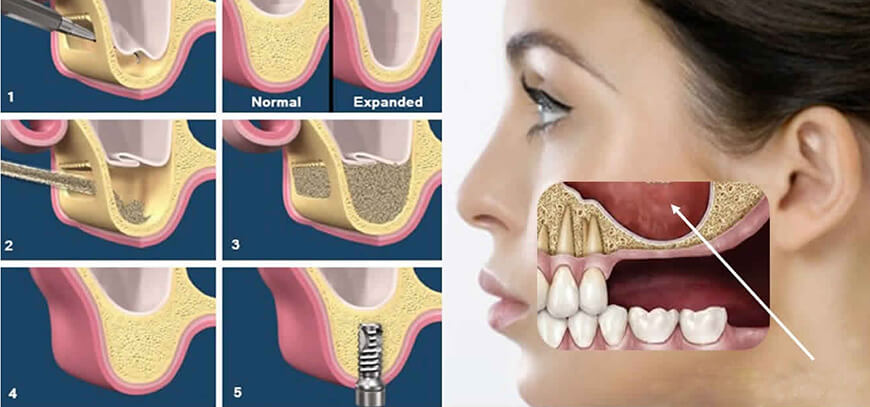
How We Decide Whether You Need One
A panoramic X-ray or photographs alone cannot support the final decision. A CBCT scan helps the clinical team evaluate the remaining bone height and width, sinus anatomy, membrane condition, septa, pathology and the position of nearby structures.
A sinus lift may be considered when:
- You need an implant in the back of the upper jaw.
- There is insufficient vertical bone beneath the sinus.
- Long-term implant positioning requires additional support.
- Previous tooth loss or bone resorption has reduced the ridge.
Treatment may be delayed or modified when:
- An active dental or sinus infection requires treatment first.
- Sinus disease requires medical or ENT assessment.
- The patient needs better control of oral hygiene or periodontal disease.
- Smoking, medication or health conditions increase surgical risk.
Clinical principle: The amount of remaining bone matters, but it does not determine the plan alone. The clinical team must assess implant position, primary stability, sinus health, graft volume, bite forces and the final prosthetic plan together.
Internal vs. External Sinus Lift
Clinicians use two principal approaches. Neither one offers an automatic advantage. The anatomy and the required augmentation determine the correct technique.
| Clinical point | Internal or transcrestal approach | External or lateral window approach |
|---|---|---|
| Typical use | Limited vertical augmentation in a suitable site | Greater augmentation or advanced posterior bone loss |
| Access | Through the implant preparation site | Through a controlled window in the lateral sinus wall |
| Implant placement | Often performed with implant placement when stability is achievable | May be simultaneous or staged according to remaining bone and stability |
| Recovery | Usually less swelling, but individual recovery varies | Swelling and bruising can be more noticeable during the first days |
The International Team for Implantology describes both transcrestal and lateral window sinus floor elevation as established approaches, with technique selection based on clinical and radiological assessment rather than a fixed number alone.
Can the Implant Be Placed at the Same Time?
Sometimes. The clinician may place the implant during the same session when enough native bone remains for primary stability and the anatomy allows safe sinus augmentation. When the remaining bone cannot provide predictable stability, a staged approach usually offers greater control. The clinician completes the sinus graft first, allows it to heal and places the implant later.
No clinic can guarantee this decision before CBCT assessment and surgical evaluation. Promising a same-day implant without reviewing the anatomy does not represent responsible treatment planning.
Send a recent panoramic X-ray or CBCT if available, along with your medical information.
Examination and CBCT confirm sinus health, bone dimensions and implant position.
You receive the recommended approach, timing, implant plan and confirmed fee.
The clinical team completes the procedure under local anaesthesia and schedules your follow-up.
Sinus Lift Cost in Turkey in 2026
At IST Smile Experts, sinus lift treatment starts from €800. A separate bone graft may start from €600 when clinically required. The technique, graft volume, membrane requirement, implant timing and CBCT findings determine the final fee.
| Procedure | Indicative 2026 fee | What determines the final fee? |
|---|---|---|
| Sinus lift | From €800 | Approach, anatomy, graft volume, membrane and surgical complexity |
| Bone graft | From €600 | Defect size, graft volume, material and membrane requirement |
| Dental implant | Quoted separately | Implant system, number of implants and restorative plan |
These figures show indicative cash-payment fees. After the clinical and radiological assessment, the team confirms the fee in writing. The team will explain any additional treatment and obtain your approval before changing the plan.
Find Out Whether You Actually Need a Sinus Lift
Send your X-ray or CBCT for an initial review. The clinical team will explain whether your in-clinic assessment should focus on a sinus lift, bone graft or alternative implant approach.
Materials and Implant Planning
Each case requires an individual graft choice. Depending on the indication, options may include processed donor-derived, animal-derived, synthetic or combined graft materials. The clinician may also use a collagen membrane. The defect, healing objective, medical history and treatment plan should guide material selection rather than marketing claims.
When the plan includes an implant, the team plans the implant system and prosthetic position within the same clinical workflow. You can review our detailed dental implants in Turkey guide, compare current treatment fees on the dental prices in Turkey page, or read the dedicated bone graft cost guide.
What Happens During the Procedure?
- Anaesthesia: The clinician administers local anaesthesia and assesses sedation suitability separately when relevant.
- Access: The clinician prepares the selected transcrestal or lateral approach according to the treatment plan.
- Membrane elevation: The clinician carefully separates and elevates the sinus membrane.
- Augmentation: The clinician places the planned graft material in the created space.
- Implant decision: The clinician places the implant during the same session only when adequate primary stability and safe positioning remain achievable.
- Closure and follow-up: The clinician closes the site, provides postoperative instructions and schedules the review.
Recovery and Aftercare
Swelling, tenderness, minor bleeding or bruising can occur during the first days. Recovery varies according to the surgical approach, graft volume, general health and individual healing response.
- Do not blow your nose during the initial healing period specified by your clinician.
- If you need to sneeze, keep your mouth open to reduce sinus pressure.
- Avoid smoking because it can impair healing and increase complication risk.
- Take prescribed medication exactly as directed.
- Maintain oral hygiene without disturbing the surgical site.
- Avoid strenuous exercise and pressure-changing travel until the clinical team clears you.
- Attend the planned review even if you feel well.
Contact the clinic promptly if bleeding does not settle, swelling increases after initially improving, you develop fever, persistent nasal discharge, severe pain, an unusual taste, fluid passing between the mouth and nose, or any symptom that concerns you.
Risks and Possible Complications
Clinical research supports sinus floor elevation as an established procedure, but it remains surgery. Clinicians most often recognise sinus membrane perforation as the main intraoperative complication. Other possible complications include infection or sinusitis, bleeding, graft exposure or loss, delayed healing, failure to obtain sufficient bone, implant failure, and the need to postpone or modify treatment.
Careful case selection, CBCT planning, control of active infection, appropriate technique, sterile clinical protocols, postoperative compliance and follow-up can reduce risk. No responsible clinic should describe the procedure as completely risk-free.
Is a Sinus Lift Always the Best Option?
No. Depending on the anatomy and restorative objective, alternatives may include a short implant, tilted implant placement, a different number or distribution of implants, a removable restoration, or no surgical treatment. A systematic review has found short implants to be a promising alternative in selected cases, but that does not make them suitable for every patient.
At IST Smile Experts, we do not add a surgical procedure automatically. We select the least invasive plan that can provide stable, maintainable and prosthetically appropriate support.
Clinically reviewed by IST Smile Experts Clinical Team
This educational guide does not replace an individual diagnosis. The clinical team confirms suitability, technique, timing and cost after clinical examination and CBCT assessment.
Frequently Asked Questions
Suitability and Treatment Planning
What is a sinus lift?
A sinus lift is a bone augmentation procedure that elevates the maxillary sinus membrane and creates additional bone height in the back of the upper jaw for selected dental implant cases.
How do I know if I need a sinus lift?
You may need one if there is insufficient bone beneath the maxillary sinus for an implant. The decision requires a clinical examination and CBCT scan, not photographs or an online quotation alone.
Is a sinus lift painful?
The clinician normally uses local anaesthesia to control pain during treatment. Swelling, tenderness and bruising can occur afterward and vary between patients.
Can the sinus lift and implant be done together?
The clinician can sometimes complete both during the same session when enough native bone remains to provide primary implant stability. If stability remains insufficient, the graft needs time to heal before implant placement.
Procedure, Timing and Cost
How long does a sinus lift take to heal?
Initial soft-tissue recovery usually occurs before the graft fully matures. Bone healing commonly takes several months. The procedure, graft and follow-up findings determine the exact implant or loading timeline.
What is the difference between an internal and external sinus lift?
An internal or transcrestal lift accesses the sinus through the implant site and generally supports limited augmentation. A lateral window approach provides access for greater augmentation when clinically required.
How much does a sinus lift cost in Turkey?
At IST Smile Experts, sinus lift treatment starts from €800 in 2026. The confirmed fee depends on the technique, graft volume, membrane requirement, implant timing and CBCT findings.
What bone graft material is used?
The clinician selects the material according to the defect and treatment objective. Options may include donor-derived, animal-derived, synthetic or combined graft materials, sometimes with a collagen membrane.
Materials, Risks and Alternatives
What are the main risks of a sinus lift?
Possible risks include sinus membrane perforation, infection or sinusitis, bleeding, graft exposure or loss, delayed healing, insufficient bone formation and implant failure.
Can I fly after a sinus lift?
Air travel may expose the healing sinus to pressure changes. Do not schedule a flight based on a general rule; follow the specific clearance and timing provided by your treating clinical team.
Can smokers have a sinus lift?
Smoking does not automatically exclude every patient, but it can impair healing and increase complication risk. Tell the clinical team about your smoking status and discuss risk reduction before treatment.
Are there alternatives to a sinus lift?
Selected patients may suit short implants, angled implant placement or a different restorative design. The clinical team must compare each alternative with the available bone, bite, prosthetic plan and long-term maintenance needs.
Clinical Evidence and Further Reading
- International Team for Implantology: Sinus Floor Elevation Treatment Guide
- ITI Consensus: Bone Augmentation and Transalveolar Sinus Floor Elevation
- Systematic Review: Implant Survival After Maxillary Sinus Floor Elevation
- Systematic Review: Short Implants Compared With Sinus Floor Elevation
Request a Case-Specific Implant Assessment
Send your current X-ray and tell us which upper teeth are missing. We will review the available information and explain the next diagnostic step before you plan your visit to Istanbul.