Clinical Answer: Multi-Layer vs Monolithic Zirconia Crowns
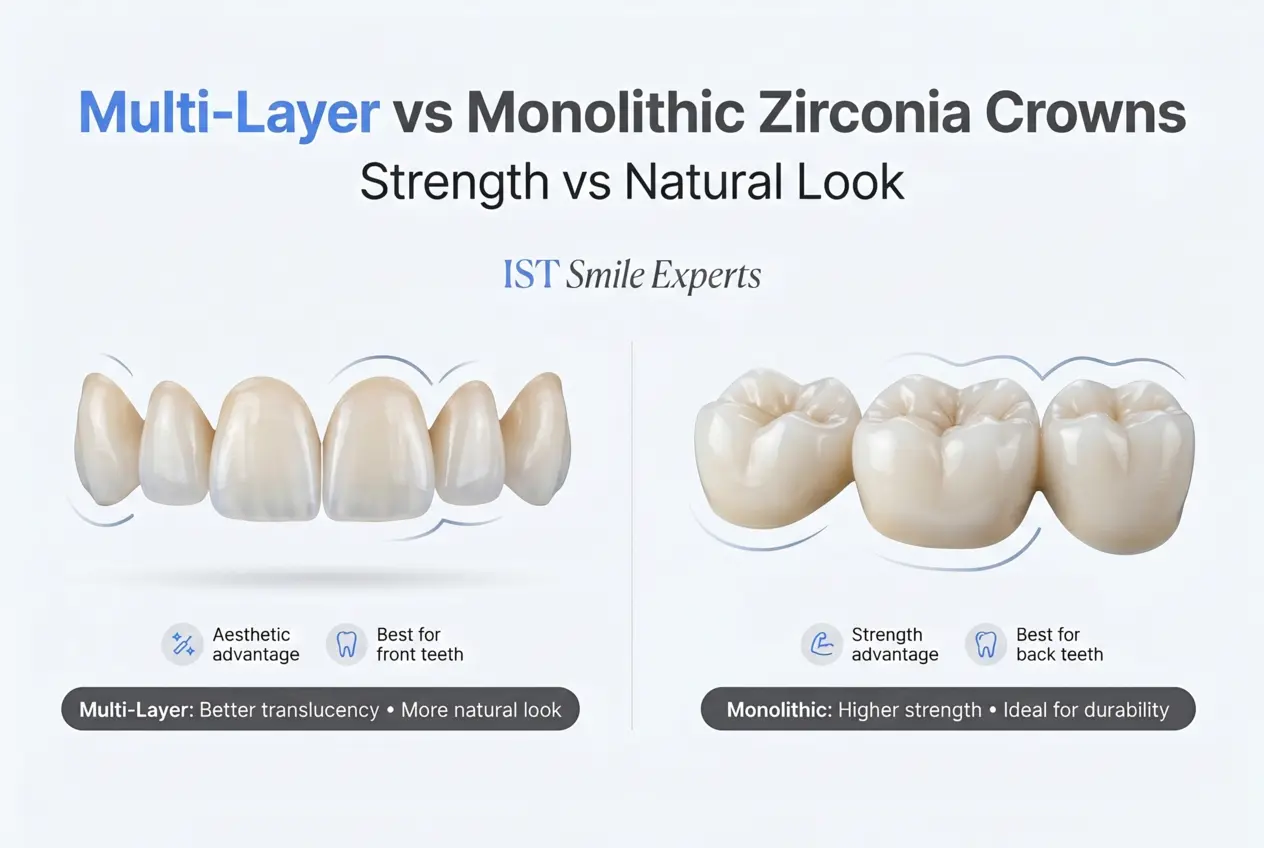
Multi-layer zirconia is usually preferred for visible front teeth because it has a built-in shade and translucency gradient that replicates natural enamel. Monolithic zirconia is usually preferred for back teeth, molars, and bruxism patients because it offers higher fracture resistance. In full-mouth crown cases, the most advanced protocol is a zone-specific combination: multi-layer zirconia in the front smile zone and monolithic zirconia in the posterior chewing zone. This approach maximises both natural aesthetics and structural durability without compromise in either direction.
At a Glance: Multi-Layer vs Monolithic Zirconia
Multi-Layer Zirconia: Pre-shaded translucency gradient built into the material. Superior aesthetics in the front tooth zone. Strength: 600-900 MPa.
Monolithic Zirconia: Single-composition high-strength block, surface-stained to shade. Superior fracture resistance. Strength: 800-1,200 MPa.
The Standard Protocol: Multi-layer for front teeth. Monolithic for back teeth. The clinical decision depends on tooth position, bite forces, and aesthetic requirements.
Both Carry: 10-year written warranty at IST Smile Experts.
What They Replace: Both eliminate the risk of porcelain chipping that exists in traditional metal-ceramic and porcelain-fused-to-zirconia crowns.
Not Sure Which Zirconia Crown You Need?
Send your photos or X-rays and our Clinical Team will tell you whether multi-layer, monolithic, or a combined zirconia protocol is right for your specific teeth.
📲 Send My Photos for Zirconia Assessment
The difference between multi-layer and monolithic zirconia is not about which material is better. It is about which material is right for the specific tooth being restored.
Multi-Layer vs Monolithic Zirconia Crowns: Strength, Translucency and Best Use
Short answer: Multi-layer zirconia crowns are best for front teeth because they look more natural under light. Monolithic zirconia crowns are best for back teeth, molars, and bruxism patients because they are stronger and more fracture-resistant. In full-mouth restorations, the best protocol is to combine both materials by tooth position.
When patients from the United Kingdom, United States, Canada, and Australia ask about zirconia crowns, the question almost always stops at “how strong is it?” and “will it look natural?” Both questions matter. But neither one can be answered properly without understanding the fundamental material science difference between the two main types of zirconia available today.
Multi-layer zirconia and monolithic zirconia are not interchangeable. They behave differently under light, they behave differently under bite load, and they are clinically appropriate for different tooth positions. A clinic that uses one material for every crown regardless of position and function is making a clinical shortcut that will compromise either the aesthetics or the durability of the result.
This guide explains the science clearly, and how IST Smile Experts uses both materials in a zone-specific protocol to deliver the best possible outcome for each individual tooth.
Multi-layer zirconia and monolithic zirconia are the two primary materials used in modern metal-free dental crown restorations. Multi-layer zirconia has a built-in translucency gradient that replicates natural tooth enamel optical behaviour and is preferred for anterior aesthetic positions. Monolithic zirconia is a single-composition high-strength material used for posterior load-bearing positions where fracture resistance matters more than maximum translucency. IST Smile Experts in Istanbul applies a zone-specific selection protocol using Ivoclar Vivadent zirconia systems, with a 10-year written warranty on all crown restorations.
What Is Zirconia and Why Did It Replace Porcelain-Fused-to-Metal?
Zirconia (zirconium dioxide, ZrO2) is a ceramic material that was adopted into restorative dentistry because it solved the two biggest problems with the previous gold standard: porcelain-fused-to-metal (PFM) crowns.
PFM crowns required a metal substructure for strength, which created a dark metal line at the gum margin that became visible over time as gums naturally recede. Furthermore, the porcelain layer applied over the metal was brittle and prone to chipping, particularly under lateral bite forces.
Zirconia eliminated both of these problems. It is fully metal-free, which means no dark margin lines. And it is dramatically stronger than porcelain, with flexural strength values that exceed almost every other dental material available in clinical practice today.
Porcelain-Fused-to-Metal (Old Standard)
- Metal substructure causes dark gum margins
- Porcelain layer chips under lateral load
- Not biocompatible with some patients
- Aesthetics degrade significantly over 10 years
Zirconia (Current Standard)
- Fully metal-free, no dark margin lines
- Exceptional fracture resistance (800-1,200 MPa)
- Highly biocompatible and suitable for most patients after clinical evaluation
- Designed for long-term aesthetic stability when properly planned, fitted, and maintained
Zirconia itself, however, is not a single material. There are two fundamentally different configurations used in modern crown restorations: multi-layer and monolithic. The difference between them is not about quality. It is about how each material manages the relationship between translucency and strength, and why that relationship matters for different teeth.
The Science of Dental Translucency: Why It Matters for Crowns
Natural tooth enamel is not opaque and it is not uniformly transparent. It is a complex semi-translucent structure that allows light to penetrate, scatter, and reflect at different depths across the tooth surface. The cervical third (near the gum) is denser and more opaque. The incisal third (at the biting edge) is thinner and more translucent, allowing light to pass through and giving natural teeth their characteristic depth and vitality.
This optical behaviour is precisely what makes natural teeth look natural. A crown material that does not replicate this gradient produces a result that looks slightly artificial, even when the shade is perfectly matched. The tooth appears flat under light rather than three-dimensional.
The Optical Properties That Define Aesthetic Success
Translucency
How much light passes through the material. High translucency at the incisal edge replicates natural enamel depth.
Opalescence
The blue-white fluorescent glow emitted under certain light conditions, naturally present in human enamel.
Value
The brightness gradient from the cervical (darker) to the incisal (brighter). Critical for the crown not looking like a flat white block.
Chroma
The colour saturation. Natural teeth are highest in chroma at the cervical third and lower toward the incisal edge.
The question for any crown material is: how effectively does it replicate these four optical properties? Multi-layer zirconia and monolithic zirconia give different answers, and that difference is fundamental to understanding which material belongs in which position in your mouth.
Multi-Layer Zirconia: How the Translucency Gradient Works
Multi-layer zirconia (also called gradient zirconia, full-contour multilayer, or translucent zirconia) is manufactured as a pre-shaded block with a built-in colour and translucency gradient. The block transitions from a more saturated, more opaque base at one end to a lighter, more translucent incisal zone at the other end. When the ceramist mills the crown blank from this block, the resulting restoration already contains the optical gradient without requiring any additional porcelain layering on top.
How Multi-Layer Achieves Its Aesthetic Quality
The multi-layer block achieves its natural appearance through material-level engineering rather than surface-level techniques. Specifically, the gradient in zirconia crystal density and grain size across the block creates differential light transmission. Light entering the crown at the incisal third encounters a different crystal structure than light entering at the cervical third, producing the depth and translucency variation that replicates natural enamel.
As a result, a well-milled multi-layer zirconia crown achieves a three-dimensional optical quality that surface staining alone cannot fully reproduce. Furthermore, this built-in gradient is stable and does not degrade over time, unlike surface characterisations that can wear with repeated polishing and cleaning.
Clinical Specifications: Multi-Layer Zirconia
| Property | Value / Detail |
|---|---|
| Flexural Strength | 600 to 900 MPa (varies by brand and generation) |
| Translucency Level | High translucency at incisal (HT-grade). Moderate at cervical. |
| Shade Source | Built into the block material. No porcelain overlay required. |
| Porcelain Layering | Not required. Full-contour design. |
| Best Position | Anterior zone (front teeth, teeth 11-13 and 21-23) |
| Bruxism Suitability | Moderate. Not ideal for severe bruxism posterior positions. |
| Primary Advantage | Maximum natural aesthetic. Replicates enamel gradient optically. |
Monolithic Zirconia: How High-Strength Single-Composition Works
Monolithic zirconia is milled from a single-composition block of high-density zirconia, typically 5Y-PSZ (5 mol% Yttria-stabilized Polycrystalline Zirconia) or 3Y-TZP at higher strength grades. The crown is milled in full contour from this uniform block and then surface-stained and glazed by the ceramist to achieve its final shade.
Why Monolithic Is Stronger
The strength advantage of monolithic zirconia comes from its single-composition structure, which eliminates the interface between core and ceramic overlay that exists in traditional layered porcelain-fused-to-zirconia systems. This interface is the most common fracture point in those older systems. By eliminating it, monolithic zirconia removes the most clinically significant failure mode from the equation.
The strength of monolithic zirconia depends on the specific grade and composition. Traditional 3Y-TZP (3 mol% Yttria-stabilized Polycrystalline Zirconia) formulations provide very high strength and fracture resistance through transformation toughening. Newer 4Y and 5Y zirconia grades improve translucency but generally reduce strength compared to 3Y formulations. As a result, material selection for monolithic zirconia must be based on the tooth position, bite force, and aesthetic demand of the specific case, not on the term monolithic alone.
Clinical note: Flexural strength values vary by zirconia generation, manufacturer, sintering protocol, and restoration design. The values listed in this article reflect typical manufacturer and published clinical ranges for modern zirconia systems, including Ivoclar Vivadent IPS e.max ZirCAD materials, which offer flexural strength values from approximately 850 MPa to 1,200 MPa depending on the specific material grade selected.
Clinical Specifications: Monolithic Zirconia
| Property | Value / Detail |
|---|---|
| Flexural Strength | 800 to 1,200 MPa (depending on grade) |
| Translucency Level | Lower than multi-layer. No built-in gradient. |
| Shade Source | Surface staining and glazing applied after milling. |
| Porcelain Layering | Not required. Full-contour monolithic design. |
| Best Position | Posterior zone (premolars, molars, teeth 14-17 and 24-27) |
| Bruxism Suitability | Excellent. Preferred material for confirmed bruxism patients. |
| Primary Advantage | Maximum fracture resistance. No ceramic overlay failure risk. |
Multi-Layer vs Monolithic Zirconia: Direct Clinical Comparison
The practical choice between the two materials comes down to three clinical factors: tooth position, bite force, and aesthetic priority. Here is the direct comparison across the factors that matter most for crown patients.
| Clinical Factor | Multi-Layer Zirconia | Monolithic Zirconia |
|---|---|---|
| Translucency | High – Built-in gradient | Lower – Surface stained only |
| Natural Appearance | Superior in anterior zone | Acceptable in posterior zone |
| Flexural Strength | 600-900 MPa | 800-1,200 MPa |
| Fracture Risk | Low (no ceramic overlay) | Very low (single material) |
| Front Teeth (Aesthetic Zone) | Preferred | Acceptable with skilled ceramist |
| Back Teeth (Load Zone) | Acceptable | Preferred |
| Bruxism Patients | Not recommended posterior | Preferred throughout |
| Full-Mouth Restoration | Front teeth in combination | Back teeth in combination |
| Long-Term Stability | Excellent | Excellent |
The most clinically advanced full-mouth zirconia restoration uses multi-layer for the anterior zone and monolithic for the posterior zone. This combination maximises both aesthetics and function without compromise in either direction.
How IST Smile Experts Selects Zirconia Material for Each Case
At IST Smile Experts, crown material selection is not a patient preference decision. It is a clinical decision made by the Senior Clinical Board based on the specific requirements of each tooth being restored. Here is the protocol applied to every case.
Step 1: Smile Zone Mapping
Our clinical team maps the visible smile zone for each patient using natural smile photography and intraoral digital scanning. The precise boundary of the aesthetic zone determines which teeth require multi-layer material and which can be restored with monolithic zirconia without visible aesthetic compromise.
Step 2: Bite Force Assessment
Bite force distribution is evaluated using digital bite registration. Patients with confirmed bruxism, elevated posterior bite forces, or previous crown fracture history are flagged for monolithic zirconia across all positions, including the front teeth where strength becomes the priority over maximum translucency.
Step 3: Case-Specific Material Assignment
Each individual tooth receives a material assignment based on its position, function, and aesthetic requirement. For a standard full-arch crown case at IST Smile Experts, the typical protocol is multi-layer zirconia for teeth in positions 13 to 23 (upper anterior) and 33 to 43 (lower anterior), with monolithic zirconia for all premolar and molar positions.
Step 4: In-House Ceramist Fabrication
Your crowns are fabricated in our in-house ceramist laboratory. This direct communication between the ceramist and clinical team eliminates the shade and fit errors that occur when crowns are outsourced to external laboratories. Furthermore, multi-layer crowns require precise block orientation during milling to position the gradient correctly relative to the gum margin. This cannot be reliably controlled by an external laboratory working from impressions alone.
Does Material Choice Affect the Cost of Zirconia Crowns?
At IST Smile Experts, the cost difference between multi-layer and monolithic zirconia crowns is absorbed into the case pricing. Patients do not pay a premium for multi-layer in the aesthetic zone. The material is selected based on clinical need, and the pricing reflects the total treatment rather than per-unit material costs.
For complete zirconia crown pricing, package details, and all-inclusive treatment information for international patients, visit our zirconia crowns packages page.
Which Zirconia Crown Is Right for You? A Simple Decision Guide
Choose multi-layer zirconia if:
The crown is on a visible front tooth, you want maximum natural translucency and depth, and your bite force is within normal range. Multi-layer is the anterior aesthetic standard.
Choose monolithic zirconia if:
The crown is on a molar or premolar, you grind your teeth, you have a confirmed strong bite force, or fracture resistance is the clinical priority. Monolithic is the posterior load-zone standard.
Choose a combined approach if:
You need a full-mouth restoration where front teeth must look natural and back teeth must handle chewing force. This zone-specific combination is the most advanced protocol and the IST Smile Experts default for full-arch cases.
When Multi-Layer Zirconia Is Not the Best Choice
Multi-layer zirconia may not be appropriate for patients with severe bruxism or very high posterior bite forces in molar positions, where its lower flexural strength (600 to 900 MPa) makes fracture more likely under repeated lateral loading. It is also not the recommended material for patients where durability must take priority over maximum translucency.
When Monolithic Zirconia Is Not the Best Choice
Monolithic zirconia may not achieve the highest aesthetic standard for highly visible anterior teeth in patients who require maximum translucency and natural enamel-like optical depth. For these patients, multi-layer zirconia in the front zone will produce a visibly more natural result, and the strength trade-off is clinically acceptable in the anterior position where bite forces are lower.
Related Clinical Information
For complete information about zirconia crown treatment in Istanbul including case selection criteria, preparation protocols, and patient journey, read our complete zirconia crowns Turkey guide.
Patients comparing zirconia crowns with E-Max veneers for aesthetic front tooth restoration should read our detailed E-Max vs zirconia vs composite comparison guide. For patients considering a full Hollywood Smile combining veneers and crowns, our Hollywood Smile Turkey guide covers the combined treatment approach in detail.
For All-on-4 and All-on-6 full-arch restorations that also use zirconia bridge material, see our All-on-4 and All-on-6 packages page.
Most patients who contact us about zirconia crowns are unsure which material is right for their specific teeth. The correct answer requires seeing your clinical situation, not just reading a comparison guide. Send us your photos and X-rays, and our Senior Clinical Board will specify exactly which material is appropriate for each tooth in your case.
Frequently Asked Questions
What is the difference between multi-layer and monolithic zirconia?
Multi-layer zirconia is milled from a pre-shaded block that transitions from a more opaque base to a more translucent incisal edge, closely mimicking the natural gradient of human tooth enamel. Monolithic zirconia is milled from a single-composition block of high-strength zirconia and then surface-stained to achieve its final shade. Multi-layer zirconia requires no additional porcelain layering and achieves its translucency gradient through the material itself. Furthermore, monolithic zirconia is significantly stronger and more fracture-resistant, making it preferable for high-load posterior positions.
Which zirconia looks more natural: multi-layer or monolithic?
Multi-layer zirconia generally achieves a more natural-looking result in the anterior aesthetic zone because its built-in translucency gradient replicates the light transmission of natural tooth enamel. Specifically, the incisal third of multi-layer zirconia allows light to pass through in a way that surface-stained monolithic zirconia cannot fully replicate. However, for posterior teeth where translucency is less visible during normal function, monolithic zirconia delivers an aesthetically acceptable result with superior strength.
Is monolithic zirconia stronger than multi-layer zirconia?
Yes. Monolithic zirconia has a flexural strength of approximately 800 to 1,200 MPa, compared to 600 to 900 MPa for multi-layer zirconia. As a result, this strength advantage makes monolithic zirconia the preferred choice for posterior crowns, molar restorations, and patients with bruxism. Furthermore, the higher zirconia content in monolithic restorations reduces the fracture risk that exists at the ceramic-zirconia interface in traditional layered porcelain-fused-to-zirconia crowns.
Specific Use Case Questions
Which zirconia crown is best for front teeth?
Multi-layer zirconia is the best choice for front teeth. Its built-in translucency gradient replicates the optical behaviour of natural tooth enamel, producing a three-dimensional depth and vitality that surface-stained monolithic zirconia cannot fully reproduce. Furthermore, for patients in the anterior aesthetic zone who want the most natural-looking result, multi-layer zirconia is the preferred clinical material.
Which zirconia crown is best for molars and back teeth?
Monolithic zirconia is the best choice for molars and posterior back teeth. Specifically, it has a flexural strength of 800 to 1,200 MPa, which handles the high chewing forces of the molar zone without fracture risk. Furthermore, the single-composition structure eliminates the ceramic overlay failure point that exists in traditional layered porcelain-fused-to-zirconia systems.
Which zirconia is best for bruxism or teeth grinding?
Monolithic zirconia is the preferred material for patients with bruxism. Its high flexural strength and single-composition structure resist the lateral grinding forces that are particularly damaging to ceramic overlay materials. In confirmed bruxism patients, monolithic zirconia may also be recommended for front teeth where durability takes priority over maximum translucency.
Can multi-layer zirconia chip?
Multi-layer zirconia is a full-contour restoration with no porcelain overlay. As a result, it does not chip in the way traditional porcelain-fused-to-zirconia crowns do, where the porcelain layer separates from the zirconia core. Fracture of the zirconia material itself is rare but possible under very high impact forces, which is why multi-layer zirconia is not recommended for posterior positions in confirmed heavy bruxism patients.
Does monolithic zirconia look fake?
Not when placed in the correct position by a skilled ceramist. Specifically, monolithic zirconia on posterior back teeth does not look fake because these teeth are not highly visible during normal smiling. On front teeth, the result depends significantly on surface characterisation and glazing technique. At IST Smile Experts, our in-house ceramist applies advanced surface staining to ensure that monolithic zirconia achieves a natural-looking finish appropriate to its tooth position.
Is Ivoclar zirconia better than generic zirconia?
Ivoclar Vivadent zirconia systems such as IPS e.max ZirCAD are clinically documented materials with consistent manufacturing standards, published flexural strength data, and extensive long-term clinical evidence. Generic or unbranded zirconia may lack the same quality control and material consistency. As a result, IST Smile Experts uses Ivoclar Vivadent zirconia exclusively for crown restorations.
Can I mix multi-layer and monolithic zirconia in one smile?
Yes. A combined zone-specific protocol using both materials is the standard approach for full-mouth zirconia restorations at IST Smile Experts. Multi-layer zirconia is placed on visible front teeth in the aesthetic zone. Monolithic zirconia is placed on premolars and molars in the posterior chewing zone. The ceramist coordinates the shade and characterisation of both materials to produce a uniform, natural-looking result across the full smile.
Which is better for a full-mouth restoration: multi-layer or monolithic zirconia?
Most full-mouth restorations use a zone-specific combination approach. Specifically, multi-layer zirconia is used for front teeth (teeth 13 to 23 and 33 to 43) where translucency is most visible. Furthermore, monolithic zirconia is used for posterior teeth (premolars and molars) where chewing forces are highest. As a result, this combination gives patients the aesthetic quality of a natural smile in the visible zone while protecting the bite with maximum-strength restorations in the back. IST Smile Experts applies this protocol by default in all full-arch restoration cases.
Can monolithic zirconia be used for front teeth?
Yes, monolithic zirconia can be used for front teeth, but it requires careful shade selection and surface characterisation by an experienced ceramist to achieve a natural result. Specifically, for patients who prioritise durability over maximum translucency, monolithic zirconia on the front teeth is a valid clinical choice. For patients who require the highest aesthetic standard in the anterior zone, multi-layer zirconia delivers a superior translucency result.
How long do multi-layer and monolithic zirconia crowns last?
Both multi-layer and monolithic zirconia crowns carry a 10-year written warranty at IST Smile Experts. Furthermore, published clinical data supports zirconia crown survival rates of 94 to 96 percent at 10 years under normal functional loading. As a result, monolithic zirconia typically shows lower fracture rates than traditional porcelain-fused-to-zirconia due to the absence of a ceramic overlay, which is the most common failure point in layered systems.
Does IST Smile Experts use Ivoclar Vivadent for zirconia crowns?
Yes. IST Smile Experts uses Ivoclar Vivadent zirconia systems for crown restorations. Ivoclar Vivadent is a Swiss manufacturer that produces clinically documented zirconia materials used by specialist restorative practices worldwide. Specifically, material selection between multi-layer and monolithic configurations is based on individual case requirements, with both options available within the IST Smile Experts clinical protocol.
Your Crown Material Should Be a Clinical Decision, Not a Guess
Before our Senior Clinical Board can specify which zirconia material is right for your case, your clinical situation must be reviewed. Each tooth has different requirements.
To begin your assessment, send us:
Recent photographs of your teeth · Any X-rays or OPG scans available · A description of which teeth need crowns and why
Our clinical team will review your case and respond with a material recommendation and full treatment plan within 12 hours.
📲 Request Your Zirconia Crown Assessment
Or email: [email protected] – we respond within 12 hours.